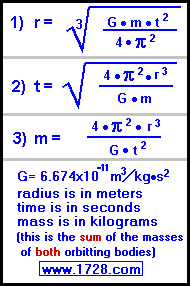
Click on the 'RADIUS' button, enter the time and mass, click on 'CALCULATE' and the answer is 4.2244 x10⁷ meters or 42,244 kilometers or 26,249 miles. (This is the distance as measured from the Earth's center).
r3 = (6.674x10⁻¹¹ • 5.9736x1024 • 86,4002) / 39.4784 r3 = 2.976x1024 / 39.4784 r3 = 7.53922 radius = 42,244,000 meters
2) The Moon orbits the Earth at a center-to-center distance of
3.86 x10⁵ kilometers (3.86 x10⁸ meters).
Now that you have this information, how long does it take the Moon to
make one revolution around the Earth?
Click on the 'TIME' button. Enter the radius and mass data. Click on
'CALCULATE' and the answer is 2,371,900 seconds or 27.453 days.
t2 = (4 • π2 • 386,000,0003) / (6.674x10⁻¹¹ • 6.0471x1024) t2 = 2.27x1027 / 4.0414 t2 = 5,626,000,000,000 time = 2,372,000 seconds
3) Every 152,850 seconds, Io orbits Jupiter at an average orbital radius of
421,700 kilometers (4.21x10⁸ meters). What is Jupiter's Mass?
m = (39.4784 • 421,700,0003) / (6.674x10⁻¹¹ • 152,8502) m = 2.961x1027 / 1.559 mass = 1.899x1027 kilograms
For easy readability, the answers are displayed in a "significant figure" format so you will not see answers such as 77.3333333333333333. Numbers larger than 1,000 will be displayed in scientific notation and with the same number of significant figures specified. You may change the significant figures displayed by changing the number in the box above. Internet Explorer and most other browsers, will display the answers properly but there are a few browsers that will show no output whatsoever. If so, enter a zero in the box above. This eliminates all formatting but it is better than seeing no output at all.
|
|||